01 / LOCATION
Ground the scene.
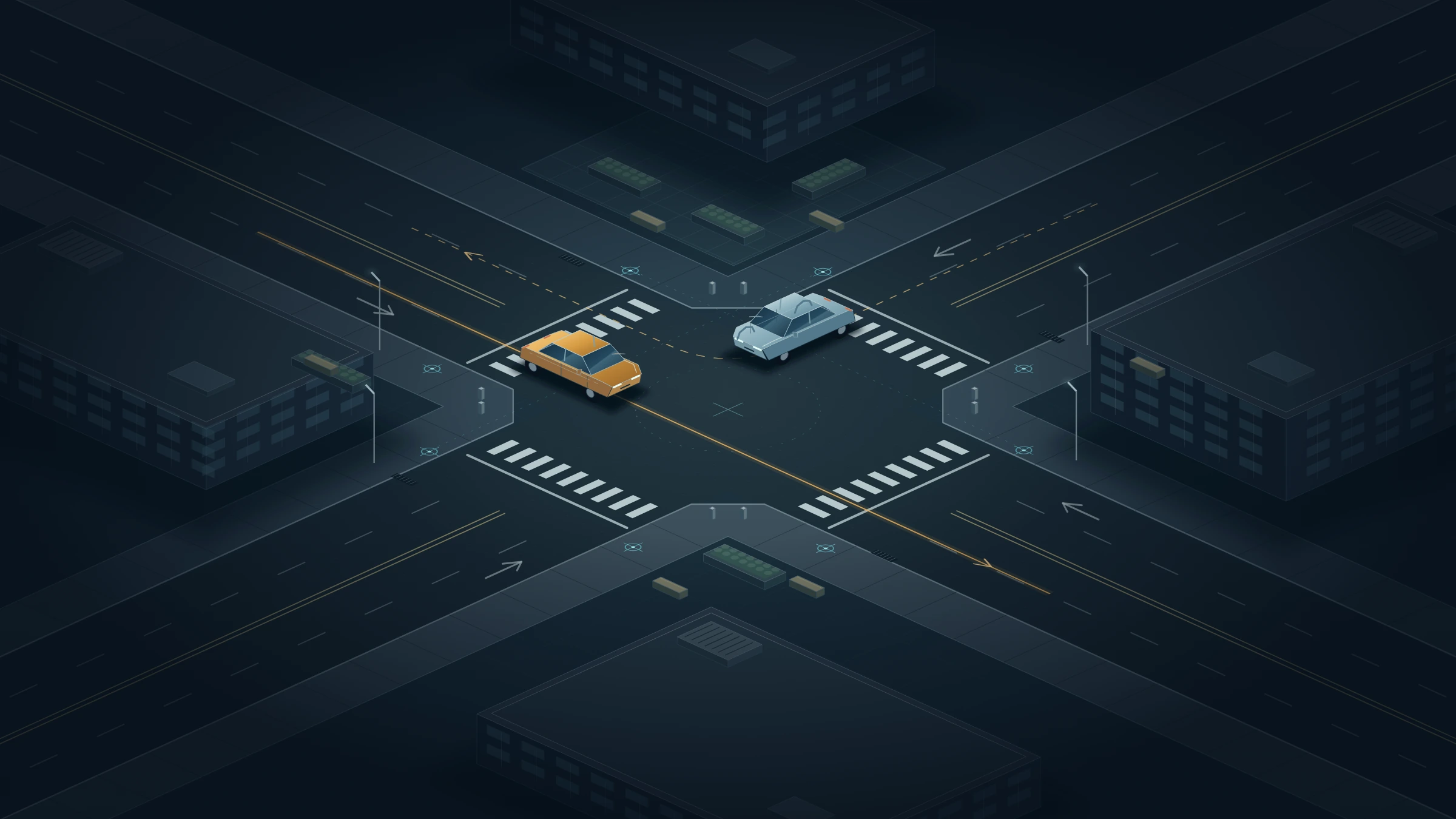
Calibrate geometry using latitude and longitude reference points, with documented source measurements and uncertainty. Model intersections, signals, buildings, terrain and obstacles.

A Quext Interactive Technologies concept
Planned Windows software
Complex events.
Clearer perspectives.
AutoQuext is planned Windows Forms software for attorneys and qualified experts to visualize accident and injury scenes, explore investigation questions, and prepare presentations for court, arbitration and mediation.
Explore the planned experienceConcept overview. The software is not currently available.
Understand the setting.
Examine the assumptions.
01 / The planned scene
A useful reconstruction needs context. AutoQuext's planned scene tools would bring the location, people, vehicles and conditions into one reviewable model.
01 / LOCATION
Calibrate geometry using latitude and longitude reference points, with documented source measurements and uncertainty. Model intersections, signals, buildings, terrain and obstacles.
02 / VEHICLES
Use appropriate vehicle dimensions and mass, document the selected values, and distinguish measured information from estimates and assumptions.
03 / PEOPLE
Place pedestrians and cyclists alongside vehicles to examine positions, sightlines and interactions within an accident or injury scene.
04 / CONDITIONS
Consider road surfaces, weather, terrain, braking and skid evidence. Planned analysis would expose its inputs and assumptions for expert review.
A model's usefulness depends on the quality of its evidence, measurements, assumptions and validation.
02 / Planned perspectives
Explore spatial relationships from above, from within the scene, and from a driver's position. Each planned view would share the same underlying scene and documented assumptions.
A top-down view for positions, distances, trajectories and the relationships between scene elements.
Adjustable cameras for scene geometry, obstructions and sightlines, with perspective and field of view made explicit.
Planned manual driving of every vehicle from its driver's viewpoint would support scenario exploration. A chosen drive-through would remain an illustrative scenario, rather than proof of the actual event.
A CLEARER PRESENTATION
A planned clean second-monitor view would help legal teams present a scene in court, arbitration or mediation while keeping working controls on the primary display.
Planned capability03 / Planned workflow
The intended workflow connects visual clarity with a traceable record. Qualified professionals would remain responsible for interpreting the evidence and evaluating the resulting model.
Document evidence provenance, reference points, measurements and source limitations. Keep original evidence distinguishable from modeled or illustrative material.
Calibrate the scene, select appropriate vehicle specifications, and record geometry, conditions and assumptions for review.
Compare views and alternative scenarios. Identify what the evidence supports, what remains uncertain, and where further investigation is needed.
Have qualified experts examine inputs, methods, limitations and conclusions. Preserve those distinctions in any presentation prepared for a legal proceeding.
04 / Responsible development
A compelling image can explain a theory. It cannot, on its own, establish what happened.
The planned product would support investigation and communication. It would not replace expert judgment, establish causation, or determine legal admissibility.
AutoQuext has no claimed or validated accuracy. Analytical methods, calibration, uncertainty and any future results would need appropriate testing and expert review before reliance.
The intended approach records sources and separates observations, estimates, hypotheses and illustrative scenarios. A visualization should not imply a certainty the record does not support.
Future shared scenarios would require privacy review. Removing names alone does not guarantee anonymity, especially when locations or event details could identify people.
05 / Development direction
These are planned directions, with no announced release dates. Availability and scope would depend on development, validation, expert input and privacy review.
Calibrated scenes, vehicle specifications, 2D and 3D cameras, manual driver-perspective exploration of every vehicle, and clean second-monitor presentation.
Organize investigation questions and possible-cause hypotheses with supporting and conflicting evidence, explicit uncertainty and expert review. Hypotheses would remain propositions to examine.
Generalized or synthetic scenarios for learning and comparison, with restricted geographic data and privacy-safe aggregate insights into intersections and road conditions.
Event counts are not exposure-adjusted risk. Correlations do not establish cause. Future geographic summaries would need clear data coverage and limitations.
Before you go
No. AutoQuext is planned software. This page explains the concept and development direction; it offers no download, purchase or release date.
No. This overview is public. All future AutoQuext software users are intended to have a Quext ID. No AutoQuext account or sign-in capability is being offered here.
This page makes no legal-admissibility claim. Any proposed use would depend on the evidence, methods, expert review, applicable requirements and the decision of the relevant forum.
No. This informational page does not collect case files or evidence. Use Quext's existing company contact navigation for general product questions, and do not send confidential case information through it.
Continue the conversation
For general questions about the AutoQuext concept, visit Quext's existing company contact workflow. Please keep inquiries free of confidential case information.
Contact QuextCompany contact · no case-data intake on this page